
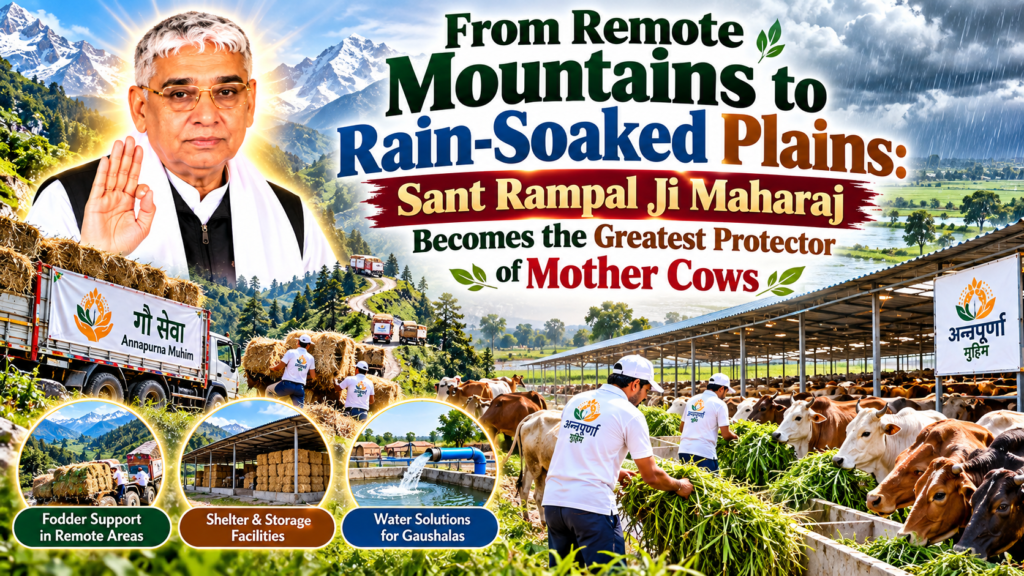
From Remote Mountains to Rain-Soaked Plains: Sant Rampal Ji Maharaj’s Cow Welfare Campaign
Published: September 2026
Category: Cow Welfare / Social Service / Annapurna Muhim
In India, cow care (Gau Seva) has long been associated with compassion, responsibility, and service toward animals. Yet running a gaushala can become extremely difficult when there is a shortage of fodder, inadequate shelter, difficult terrain, or heavy rainfall.
According to the Annapurna Muhim, initiatives associated with Sant Rampal Ji Maharaj have provided assistance to gaushalas facing such challenges. One recently published account describes support in the remote hills of Sahiya, Dehradun, Uttarakhand, while another describes shelter-related assistance at a gaushala in Bali Brahman village, Sonipat, Haryana.
A Mission Focused on Livestock Welfare
The campaign is presented as part of a broader welfare initiative known as Annapurna Muhim. Its website describes the mission as providing essential assistance such as food, clothing, education, medical support, and shelter to people in need.
Alongside these activities, the associated Pashudhan Bachao, Shuddh Jal Pilao Abhiyan focuses on issues affecting livestock, including fodder and water availability.
Recent reports describe assistance reaching different geographical regions, showing how livestock-related problems can vary dramatically from one location to another.
Sahiya, Uttarakhand: Fodder Reaches a Remote Mountain Gaushala
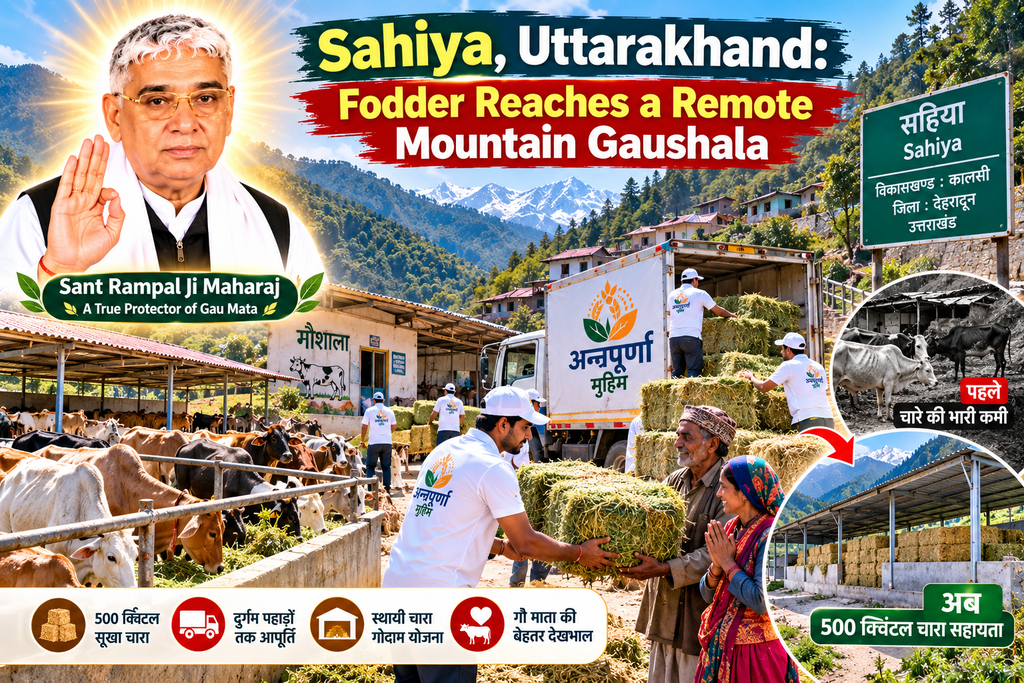
One of the most challenging examples comes from Sahiya in the Kalsi area of Dehradun district, Uttarakhand.
According to the Annapurna Muhim report, the Gau Sanrakshan Seva Samiti operated in a difficult mountainous location that was hard to access with heavy supplies. The report says that the gaushala was struggling to obtain dry fodder for abandoned and injured cattle.
The report states that 500 quintals of dry fodder were approved, with an initial 50-quintal consignment reaching the gaushala. It also says that a permanent storage shed was planned to protect fodder from the harsh mountain weather.
Why Mountain Locations Are Different
Providing livestock support in mountainous areas involves challenges that may not exist in plains:
- Difficult roads and transportation
- Steep terrain
- Limited storage facilities
- Weather-related disruptions
- Difficulty transporting large quantities of fodder
The Sahiya example illustrates how basic livestock needs can become a major logistical challenge when a gaushala is located far from major roads.
Bali Brahman, Haryana: Protecting Fodder from Heavy Rain
The second example comes from Bali Brahman village in Gohana tehsil, Sonipat district, Haryana.
According to the published report, the Shri Krishna Bhagwan Gaushala had been facing problems because there was no adequate roof over the fodder storage area. During the monsoon and sudden rainfall, fodder could become wet and spoil.
The report says that a large permanent shed was initiated to provide protection from rain and help keep fodder dry.
This type of infrastructure can be particularly important because maintaining a regular fodder supply is not only about obtaining feed—it is also about storing it properly.
From Temporary Arrangements to Permanent Infrastructure
The reported intervention at Bali Brahman highlights a different side of livestock welfare.
While Sahiya faced the problem of getting fodder into a remote location, Bali Brahman faced the problem of protecting fodder from the weather.
Both situations require different solutions:
Mountain region:
Fodder transportation + storage
Rain-affected plains:
Permanent shelter + protected fodder storage
This demonstrates why livestock welfare programs often need to address infrastructure and logistics alongside the immediate distribution of food.
Water Is Another Major Livestock Challenge
Fodder is only one part of livestock welfare. Water availability can become equally important, particularly during drought or when traditional ponds and water sources dry up.
A September 2026 report from Mirzapur Khedi village in Sonipat district, Haryana, described a village pond that had reportedly remained dry for approximately two to three years. According to SA News, a request was submitted under the Pashudhan Bachao Shuddh Jal Pilao Abhiyan.
The report says that a technical survey resulted in a proposal for 4,400 feet of 8-inch pipeline and a 7.5 HP motor, along with related electrical and piping equipment. It also describes the proposed system as having a dual purpose: supplying water to the pond during dry periods and helping remove excess water during waterlogging.
This is an example of how livestock welfare can involve long-term infrastructure rather than one-time assistance.
A Wider Network of Gaushala Assistance
Other reports published during September 2026 describe fodder assistance to gaushalas in Rajasthan and other regions.
For example, publicly available reports associated with the campaign describe large quantities of dry fodder being supplied to different gaushalas in districts such as Hanumangarh, Churu and Jhunjhunu. One reported distribution on September 10 totaled 4,260 quintals, while another reported distribution on September 16 totaled 3,325 quintals, along with infrastructure and equipment.
These figures come from campaign-associated and social-media reporting, so they should be understood as reported figures rather than independently audited national totals.
The Human Side of Cow Welfare
Supporting cattle also indirectly supports the people who depend on them.
In rural India, livestock can be connected to:
- Dairy production
- Household income
- Agricultural activities
- Rural livelihoods
- Local gaushala operations
- Community food systems
When cattle face fodder or water shortages, the impact can therefore extend beyond the animals themselves.
Providing fodder, water infrastructure, transportation assistance, and shelter can help gaushala operators focus on the daily care of the animals rather than dealing exclusively with emergency shortages.
More Than Just Fodder
The examples from Uttarakhand and Haryana show that cow welfare can require several forms of assistance.
1. Fodder Support
Providing dry fodder during periods of shortage can help gaushalas maintain regular feeding.
2. Storage Facilities
A proper shed can protect fodder from rain and other weather conditions.
3. Water Infrastructure
Pipelines, motors and ponds can help address long-term water shortages.
4. Transportation
In remote locations, simply delivering a large quantity of fodder can become a major challenge.
5. Long-Term Planning
Permanent infrastructure can potentially reduce repeated emergency problems.
From the Mountains to the Plains
The stories from Sahiya and Bali Brahman represent two very different geographical environments.
In the mountains of Uttarakhand, the central challenge described was accessibility and fodder supply.
In the rain-affected plains of Haryana, the challenge involved protecting fodder and cattle from rainfall.
Meanwhile, other reported projects have focused on water availability, particularly in villages where livestock depend on ponds and other community water sources.
Together, these examples illustrate the different forms that livestock welfare can take across India.
Conclusion
The campaign-associated reports portray Sant Rampal Ji Maharaj and the Annapurna Muhim as supporting gaushalas through fodder distribution, storage infrastructure and livestock water projects in different parts of India.
From the difficult terrain of Sahiya in Uttarakhand to the rain-prone plains of Sonipat in Haryana, the reported interventions focus on practical problems faced by gaushalas: food, shelter, storage, transportation and water.
The title of this article describes Sant Rampal Ji Maharaj as a “greatest protector” because that is the characterization used in the campaign’s original Hindi article; whether that broader characterization is justified is a matter for readers to evaluate based on the documented evidence and independently verifiable records.
What remains clear from the reported cases is that effective cow welfare requires more than compassion—it also requires resources, infrastructure, logistics and sustained effort.