

Sant Rampal Ji Maharaj: A Nationwide Relief and Livestock Welfare Campaign Through Annapurna Muhim
Across India, humanitarian initiatives often become especially important when families face food insecurity, natural disasters, or difficulties in maintaining livestock. In this context, Annapurna Muhim, associated with Sant Rampal Ji Maharaj, presents itself as a service initiative focused on supporting needy families and providing assistance related to food, clothing, education, healthcare, housing, and disaster relief.
At the same time, recent reports associated with the campaign describe a broader “Pashudhan Bachao” (Save Livestock) effort involving fodder, shelter, and other forms of assistance for gaushalas and livestock-keeping communities.
What Is Annapurna Muhim ?
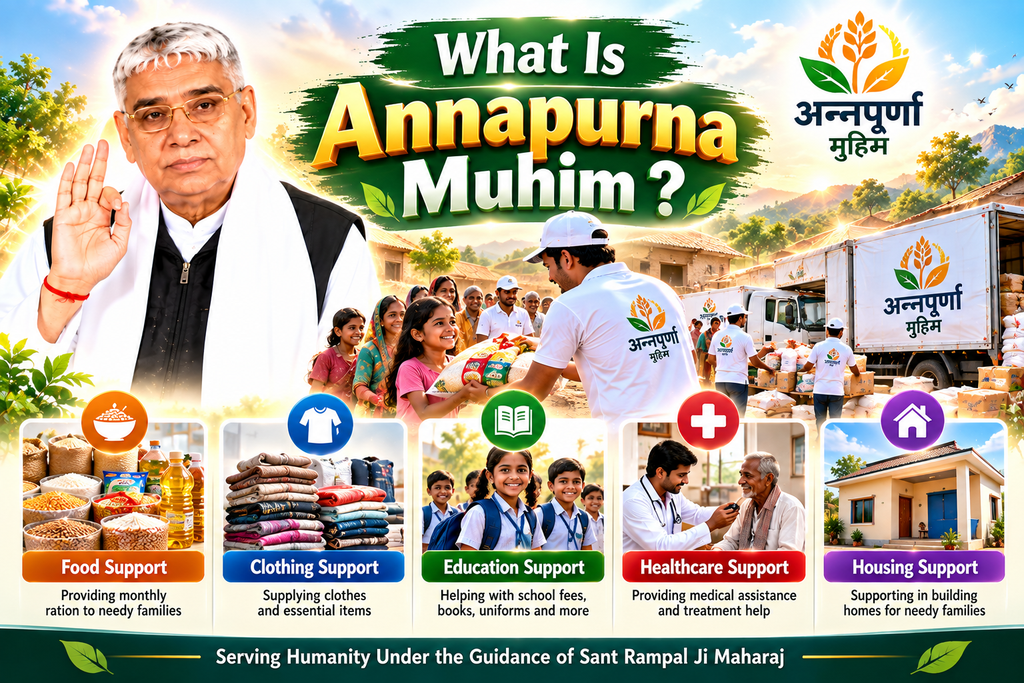
According to the campaign’s own description, Annapurna Muhim aims to help underprivileged and needy families meet basic requirements and live with greater dignity. Its stated areas of assistance include food, clothing, children’s education, medical support and housing.
The initiative describes its work not simply as occasional food distribution, but as longer-term assistance for families facing difficult circumstances. Its published material says that support can include monthly ration, educational expenses, medical assistance and housing for families who need it.
This makes the campaign broader than a conventional food-distribution drive: it presents itself as a combination of immediate relief and continuing support.
From Food Relief to Livestock Protection
Another important aspect highlighted in recent campaign reporting is assistance for livestock.
For rural families, cattle and other livestock can be closely connected with their livelihood. During periods of flooding, drought, fodder shortages or inadequate shelter, animals can become particularly vulnerable.
A September 29, 2026 report associated with the campaign describes activities under “Pashudhan Bachao, Shuddh Jal Pilao” and related relief initiatives. The report mentions fodder, tin sheds, water pipelines and other forms of support for affected communities and gaushalas in parts of Haryana and Rajasthan.
Recent listings from the same news network also mention fodder assistance to gaushalas, including reports concerning 500 quintals of fodder in Madhavgarh, Jhunjhunu and 200 quintals for Shri Krishna Gaushala in Adhmi, Panipat. These are reported claims from the campaign’s associated news outlet rather than independently audited figures.
Helping Families With More Than Food
One of the distinguishing features promoted by Annapurna Muhim is its emphasis on several basic necessities together.
The campaign’s published information describes assistance such as:
- Monthly ration and essential food items
- Clothes and household necessities
- School fees, uniforms, shoes and educational materials
- Medical assistance
- LPG and other household support
- Construction of houses for some needy families
For example, a January 2026 report from the campaign described assistance provided to a needy family in Chitana village, Sonipat, including continued attention to the family’s future requirements.
Another published case from Gurdpal Nagar, Ludhiana, listed groceries and household essentials supplied to a family and described additional assistance after the family reported that its LPG cylinder was empty.
Such individual cases illustrate how the campaign presents its approach: identify a family’s immediate needs and then continue support when necessary.
Disaster Relief and Rural Support
The campaign’s official social-reform material also lists disaster relief among its activities, including assistance during floods and other natural disasters.
A separate English-language page associated with Sant Rampal Ji Maharaj describes relief operations in flood-affected areas and assistance aimed at farmers whose agricultural land was affected by water.
These activities are particularly relevant in rural areas, where damage to crops, homes, roads and livestock can affect an entire family’s livelihood.
The Human Side of the Mission

Beyond statistics and materials, humanitarian campaigns are ultimately about people.
A family struggling to buy food may need more than a one-time ration packet. A child who lacks school supplies may need continuing educational support. A homeless family may require a safe house rather than temporary assistance. Similarly, livestock owners may need fodder, clean water and proper shelter to protect their animals.
This is why the idea of combining food, education, healthcare, housing and livestock support can have significance for rural and economically vulnerable communities.
The Annapurna Muhim website describes its objective in terms of helping disadvantaged people meet necessary requirements and live with dignity.
A Message of Service
Sant Rampal Ji Maharaj’s associated social-reform material presents service to humanity as an important part of its broader mission. It lists Annapurna Muhim alongside blood donation, medical camps, disaster relief and other social initiatives.
The campaign therefore combines a spiritual message with practical service activities. Whether the focus is a needy family, a school-going child, a person requiring medical help, or livestock needing food and shelter, the stated objective is to provide tangible assistance.
Conclusion
Annapurna Muhim and the associated Pashudhan Bachao initiatives represent a broad humanitarian-service model that combines assistance to people with support for livestock and rural communities.
According to campaign-associated sources, its activities include ration distribution, clothing, education, healthcare, housing, disaster relief, fodder distribution, livestock shelters and water-related support.
As with any large social initiative, individual claims, numbers and specific relief activities should be evaluated using dated reports, photographs, official records and independent sources where available. But the central theme of these initiatives is clear: supporting people in need while extending care toward vulnerable livestock and rural communities.