
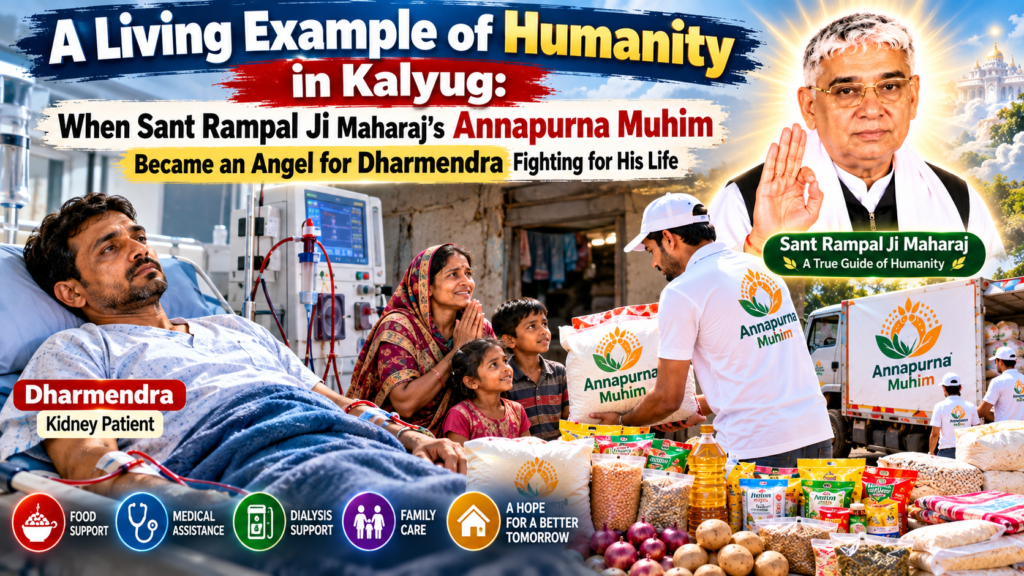
In the Darkest Hour of Illness: When Sant Rampal Ji Maharaj’s Annapurna Muhim Became a Lifeline for Dharmendra
Serious illness can change an entire family’s life. When a person requires long-term medical treatment, the financial burden can become especially difficult for families with limited income. In such circumstances, assistance with food and essential household needs can provide meaningful relief.
A case reported in August 2026 concerns Dharmendra Bansod, described by a local news report as a kidney patient facing serious illness and financial difficulties. According to the report, assistance was provided to Dharmendra’s family under the Annapurna Muhim associated with Sant Rampal Ji Maharaj, including ration support and a commitment to assist with his treatment and regular dialysis.
This article examines the reported case, the nature of the assistance described, and the broader objectives attributed to the Annapurna Muhim.
Dharmendra’s Struggle With Serious Illness
According to a report published by Chhattisgarh 24 News on August 13, 2026, Dharmendra Bansod was suffering from a serious kidney-related illness.
The report says that his family’s financial condition was weak and that meeting the expenses associated with treatment was difficult. For a patient requiring continuing medical care, expenses can extend beyond hospital treatment to medicines, transportation, nutrition and other household needs.
In Dharmendra’s case, the reported financial pressure became an additional challenge alongside his health condition.
Annapurna Muhim Reaches Dharmendra’s Family
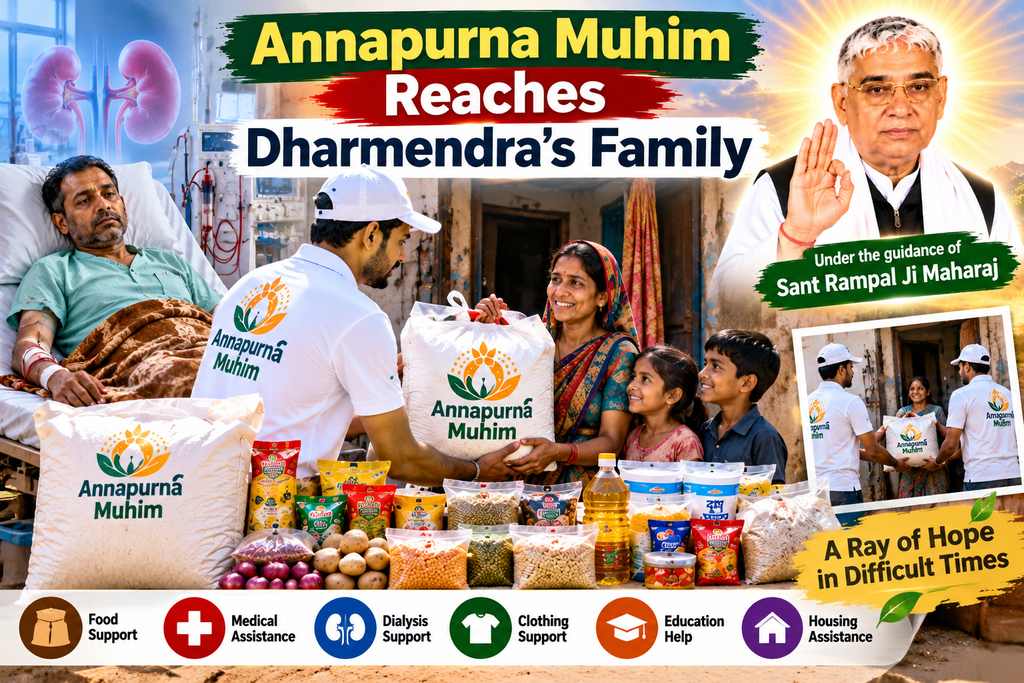
The report states that assistance was provided to Dharmendra Bansod and his family through the Annapurna Muhim.
According to the published account, the family received essential ration supplies, helping address their immediate household needs during a difficult period. The report also says that Dharmendra was taken under the initiative’s long-term support and that assistance toward his treatment and regular dialysis was promised.
This is significant because food insecurity can add another layer of difficulty to families already dealing with serious medical conditions.
The reported assistance included:
- Essential ration supplies
- Support for the family’s basic needs
- Assistance toward medical treatment
- Support for regular dialysis
- Continued assistance during the period of illness
The details above are based on the August 13, 2026 report and should be understood as reported information, rather than an independently audited medical or financial record.
Why Medical Illness Can Create a Financial Crisis
A serious disease can affect a household in several ways at the same time.
1. Medical expenses
Long-term treatment can involve repeated hospital visits, medicines, tests and procedures.
2. Loss of earning capacity
If the patient is unable to work, household income may fall while expenses increase.
3. Transportation costs
Regular medical appointments may require repeated travel to hospitals or dialysis centres.
4. Household expenses continue
Even during illness, families still need food, electricity, clothing, education and other daily necessities.
5. Emotional pressure
A serious illness can place considerable emotional pressure on both the patient and family members.
For this reason, support that addresses both immediate household requirements and medical-related expenses can be particularly important for economically vulnerable families.
What Is the Annapurna Muhim?
The Annapurna Muhim is described by its associated website as a social-service initiative focused on helping needy families with basic necessities.
According to the initiative’s published information, assistance can include:
- Food and monthly ration
- Clothing
- Education-related expenses
- Medical assistance
- Housing
- Other essential household requirements
The initiative says that its volunteers identify families facing severe financial difficulties and provide assistance according to their circumstances.
The broader campaign is presented as being guided by Sant Rampal Ji Maharaj.
Beyond One-Time Food Assistance
One notable aspect of the Dharmendra Bansod case is that the published report does not describe the assistance as being limited to a single ration distribution.
Instead, it says that the initiative committed to supporting his treatment and regular dialysis while also providing essential ration supplies to the family.
For a person requiring ongoing medical care, continuity can be important.
A one-time package of food may provide immediate relief, but continuing medical expenses can remain a challenge. The reported commitment to assist with treatment therefore represents a broader form of support.
Dialysis: Why Regularity Matters
Dialysis is a medical treatment used for people whose kidneys are unable to adequately perform certain essential functions.
Patients who require regular dialysis generally need to follow a continuing treatment schedule determined by their medical team.
This makes financial support particularly relevant for families that struggle to afford repeated treatment.
It is important to clarify, however, that financial or charitable assistance should not be considered a replacement for professional medical care. Kidney patients should continue treatment under qualified medical professionals.
In Dharmendra’s reported case, the assistance described by the news report was intended to help with treatment and dialysis rather than replace medical supervision.
Support for the Family Matters Too
When one member of a household becomes seriously ill, the entire family can be affected.
The family may have to manage:
- Medical appointments
- Food expenses
- Household responsibilities
- Reduced income
- Children’s needs
- Transportation
- Medicine and treatment costs
That is why the reported ration assistance to Dharmendra’s family is an important part of the story.
Food assistance can help a family maintain basic household needs while it focuses on a serious medical situation.
A Broader Humanitarian Approach
The Annapurna Muhim’s associated publications describe its activities as extending beyond food distribution.
According to these publications, the initiative aims to help families with food, clothing, education, medical assistance and housing. Some published case studies describe assistance to families dealing with illness, poverty, loss of income and housing insecurity.
For example, associated publications describe assistance involving ration, school expenses, clothing and medical support for families affected by serious illness.
These accounts present the campaign as an attempt to address multiple basic needs rather than focusing on only one problem.
From Food Security to Medical Support
The reported Dharmendra case demonstrates an important connection between food security and healthcare.
Imagine a family facing a serious medical condition while also struggling to purchase basic food.
Even if medical treatment is available, the family can still experience financial stress because household expenses continue.
A coordinated support system can therefore potentially help in several areas:
Food → reducing immediate household pressure
Medical assistance → helping with treatment-related expenses
Dialysis support → addressing recurring treatment needs
Family support → helping relatives manage everyday necessities
The Dharmendra Bansod report describes this combination of support under the Annapurna Muhim.
Humanitarian Service During Difficult Times
The central human element of this story is simple: a family facing illness and financial hardship received assistance when it was struggling to manage its basic needs.
According to the published report, Dharmendra’s family expressed gratitude for the assistance provided. The report also states that local ward councillor Sunita Devi Baghel was present and praised the initiative’s assistance to poor and vulnerable people.
Such statements are part of the source’s reporting and should be understood as attributed comments rather than independently verified assessments.
The Wider Vision of Annapurna Muhim
Publications associated with the campaign describe the Annapurna Muhim using the principle of helping people with basic necessities.
Its commonly described areas of assistance include:
Food
Regular ration support for families struggling to afford essential groceries.
Clothing
Clothing assistance for families in financial difficulty.
Education
Support for children’s school-related needs, including fees and educational materials in some reported cases.
Healthcare
Assistance for people facing serious medical or financial difficulties.
Housing
Construction or support for permanent homes for families without adequate shelter in some reported cases.
The campaign’s own publications describe these services as part of a wider humanitarian mission.
Why Stories Like Dharmendra’s Matter
Cases involving serious illness often reveal a second problem that receives less attention: financial vulnerability.
A person may already be dealing with the physical challenges of disease. At the same time, their family may be worried about how to pay for food, medicines and treatment.
The reported support for Dharmendra Bansod illustrates how social assistance can attempt to address these interconnected difficulties.
It also highlights the importance of ensuring that vulnerable patients have access to appropriate medical treatment while their families receive support with essential living expenses.
Compassion and Practical Assistance
Humanitarian work becomes meaningful when compassion is translated into practical action.
In this reported case, the assistance was not described only in terms of encouraging words. It included tangible support:
Ration for the household.
Medical-treatment assistance.
Support for regular dialysis.
Long-term family support.
These are practical forms of assistance that directly relate to the difficulties described in the report.
The Role of Community Support
Large humanitarian initiatives often depend on networks of people who identify needs and deliver assistance.
According to publications associated with the Annapurna Muhim, volunteers and followers participate in identifying families and helping deliver essential supplies.
In cases involving serious illness, such community networks can be particularly useful because a vulnerable family may have difficulty arranging every aspect of support on its own.
However, charitable assistance works best alongside established healthcare systems and professional medical treatment.
A Note About the “Angel” Description
The original title describes the Annapurna Muhim as becoming an “angel” for Dharmendra.
That is a figurative and devotional characterization, not a medically or independently verified description.
The underlying factual point reported by the local news source is that Dharmendra Bansod, described as a kidney patient facing financial difficulties, received ration assistance and that support for treatment and regular dialysis was promised under the initiative.
Readers can evaluate the broader significance of the initiative based on these reported facts and any independently available documentation.
Conclusion: A Story of Illness, Support and Human Dignity
The story of Dharmendra Bansod illustrates the difficulties that can arise when serious illness and financial hardship occur together.
According to a report published on August 13, 2026, Dharmendra, described as a kidney patient, was facing difficulty meeting treatment expenses. Under the Annapurna Muhim associated with Sant Rampal Ji Maharaj, his family reportedly received essential ration supplies, while assistance for his treatment and regular dialysis was promised.
The case also reflects a broader approach described by the Annapurna Muhim, which includes food, clothing, education, healthcare and housing assistance for needy families.
For a family living through a serious medical crisis, support with basic necessities can provide breathing space and help preserve dignity.
Ultimately, the most important lesson from such cases is that humanitarian support is not only about giving material resources—it is also about standing beside people when they are facing some of the most difficult moments of their lives.
Frequently Asked Questions
1. Who is Dharmendra Bansod?
Dharmendra Bansod is identified in an August 2026 local news report as a kidney patient facing serious illness and financial difficulties.
2. What assistance was reportedly provided to his family?
The report states that the family received essential ration supplies and that assistance toward Dharmendra’s treatment and regular dialysis was promised.
3. What is the Annapurna Muhim?
It is described by its associated publications as a social-service initiative providing assistance related to food, clothing, education, healthcare and housing for needy families.
4. Does ration assistance treat kidney disease?
No. Ration assistance does not treat kidney disease. Kidney patients require appropriate medical evaluation and treatment from qualified healthcare professionals.
5. Why is dialysis support important?
For people who require dialysis, treatment is generally ongoing and can create recurring financial and logistical challenges. Support with treatment costs can therefore be important for economically vulnerable families.