
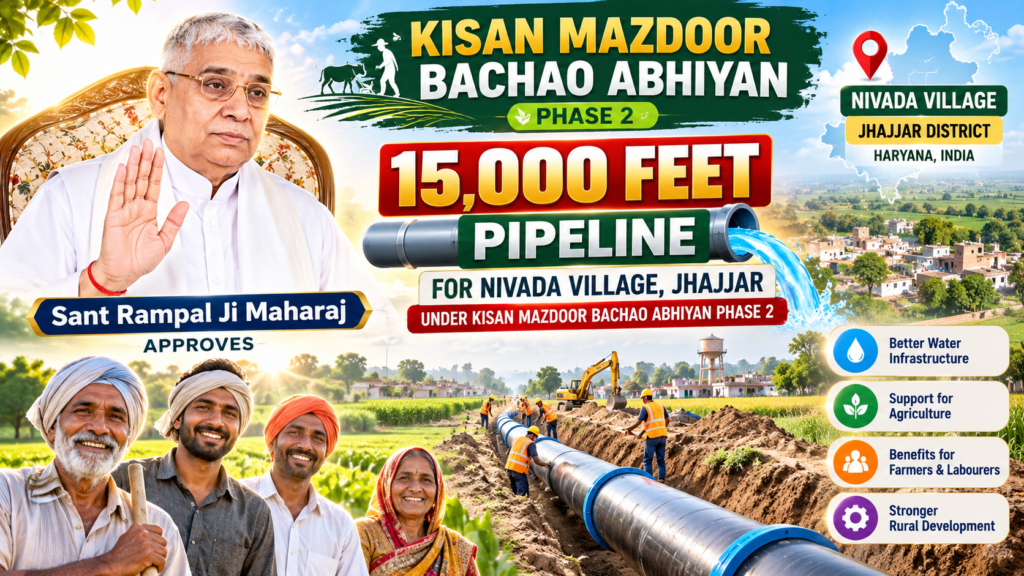
Sant Rampal Ji Maharaj Approves 15,000 Feet Pipeline for Village Nivada, Jhajjar Under Kisan Mazdoor Bachao Abhiyan Phase 2
Introduction
Under the Kisan Mazdoor Bachao Abhiyan Phase 2, a significant development has been reported for the residents of Nivada village in Jhajjar, Haryana, with the approval of a 15,000-feet pipeline aimed at addressing an important local infrastructure and water-related requirement.
The initiative has been associated with Sant Rampal Ji Maharaj and his welfare-oriented campaign for farmers and laborers. The proposed pipeline is expected to support the needs of the local community and strengthen essential infrastructure in the village.
This development has drawn attention because water availability and agricultural infrastructure remain important concerns for rural communities, particularly for farmers whose livelihoods depend heavily on reliable water resources.
What Is the Kisan Mazdoor Bachao Abhiyan?
The Kisan Mazdoor Bachao Abhiyan is presented as a welfare initiative focused on supporting farmers, workers, and economically weaker sections of society.
The campaign emphasizes assistance related to basic needs and community welfare. Its second phase, commonly referred to as Kisan Mazdoor Bachao Abhiyan Phase 2, has been associated with additional initiatives intended to address practical problems faced by rural communities.
The reported pipeline approval for Nivada is being highlighted as one such local infrastructure initiative.
15,000 Feet Pipeline Approved for Nivada Village
According to the information provided for this initiative, a 15,000-feet-long pipeline has been approved for Nivada village in Jhajjar district, Haryana.
The length of the proposed pipeline is approximately:
15,000 feet = about 2.84 miles = about 4.57 kilometres
Such infrastructure can be particularly important in rural areas where the availability and distribution of water can directly affect agriculture, livestock, and everyday community needs.
Why Is the Pipeline Important?
For farming communities, water infrastructure is closely connected with agricultural productivity.
A properly planned pipeline can potentially help with:
- Improving water distribution
- Supporting agricultural activities
- Reducing difficulties associated with water transportation
- Improving access to water infrastructure
- Supporting farmers and rural households
- Strengthening village-level infrastructure
- Helping address local water-management challenges
The actual benefits, however, will depend on the pipeline’s source, route, capacity, intended beneficiaries, implementation, and maintenance.
Importance for Farmers
Farmers depend on reliable infrastructure to maintain agricultural activities. Water availability can influence crop planning, irrigation, livestock care, and overall farm productivity.
The reported approval of the 15,000-feet pipeline therefore represents an infrastructure development that may be particularly relevant to the farming community of Nivada.
For farmers, infrastructure projects of this kind can be valuable when they are implemented properly and connected to a dependable water source.
Importance for Labourers and Rural Families
The campaign’s focus is not limited to agriculture. Rural labourers and families also depend on basic infrastructure and community resources.
Better infrastructure can contribute to:
- Improved living conditions
- Reduced daily difficulties
- Better support for agricultural work
- Greater community resilience
- More efficient use of local resources
In this context, the initiative is being presented as part of a broader effort to support rural communities.
Sant Rampal Ji Maharaj and the Welfare Initiative
Sant Rampal Ji Maharaj has been associated by his followers with various social-welfare initiatives aimed at helping people in need.
The Kisan Mazdoor Bachao Abhiyan is presented as one of these initiatives, with a focus on farmers and labourers.
The reported Nivada pipeline approval has consequently become an example highlighted in connection with the campaign’s second phase.
For accurate public communication, however, details such as the approval authority, funding source, project execution agency, pipeline route, and completion status should be verified through official documentation or the responsible local authority.
Nivada Village, Jhajjar, Haryana
Nivada is a rural settlement in Jhajjar district of Haryana.
Like many villages in Haryana, agricultural activity and rural livelihoods make basic infrastructure particularly important. Water management can have a direct relationship with farming, livestock, and household requirements.
A pipeline project extending approximately 15,000 feet could therefore represent a substantial piece of village-level infrastructure if implemented according to the stated plan.
What Does 15,000 Feet Mean?
The figure 15,000 feet can be difficult to visualize.
For easier understanding:
- 15,000 feet
- Approximately 4,572 metres
- Approximately 4.57 kilometres
- Approximately 2.84 miles
This means the proposed pipeline would cover a considerable distance within the relevant project area.
The exact route, however, may not be a straight line and could depend on roads, fields, existing infrastructure, land ownership, water-source location, and engineering requirements.
Potential Impact on the Local Community
If successfully implemented, the pipeline could potentially provide several benefits to the Nivada community.
1. Better Water Infrastructure
The project could strengthen the existing water-distribution network and improve connectivity between the water source and intended users.
2. Support for Agriculture
Reliable water infrastructure can help farmers manage irrigation requirements more effectively.
3. Reduced Water-Transportation Difficulties
Where water has to be transported over long distances, pipeline infrastructure can potentially make distribution more efficient.
4. Support for Livestock
Farm families often maintain cattle and other livestock. Reliable water infrastructure can also support livestock-related needs.
5. Community Development
Infrastructure improvements can contribute to broader rural development when combined with proper maintenance and responsible resource management.
Kisan Mazdoor Bachao Abhiyan Phase 2
The second phase of the campaign is being presented as an expansion of welfare-oriented activities for farmers and workers.
The reported approval for Nivada is particularly notable because it focuses on a concrete infrastructure requirement rather than only providing short-term assistance.
Projects involving infrastructure can have longer-term value because, when properly implemented and maintained, they can continue benefiting communities for many years.
From Approval to Implementation
Approval of a project is only the first stage. For the pipeline to deliver its intended benefits, several steps are generally required.
These may include:
- Finalizing the project design
- Conducting a technical survey
- Determining the pipeline route
- Identifying the water source
- Obtaining necessary permissions
- Procuring required materials
- Carrying out excavation and installation
- Connecting the pipeline
- Testing the system
- Starting operations
- Establishing a maintenance system
The actual process will depend on the responsible organization and applicable government or local regulations.
Transparency and Verification
When reporting a community-development project, it is important to distinguish between approval, construction, and completion.
An approved pipeline does not necessarily mean that the entire pipeline has already been constructed or become operational.
Readers should therefore look for official information regarding:
- Approval date
- Project cost
- Funding source
- Project authority
- Pipeline route
- Water source
- Construction status
- Expected completion date
- Current operational status
Providing these details helps maintain transparency and ensures that readers understand the project’s actual stage.
Why Rural Infrastructure Matters
Infrastructure plays a major role in rural development.
Farmers and workers need access to reliable resources, transportation, water, electricity, healthcare, education, and markets. Improvements in these areas can reduce practical difficulties and contribute to economic stability.
Water infrastructure is particularly important because agriculture, livestock, and household activities can all depend on dependable water availability.
A Step Toward Rural Development
The reported 15,000-feet pipeline approval for Nivada can be viewed as an example of how a local infrastructure project may address a specific community requirement.
Whether the project achieves its intended impact will ultimately depend on its implementation, technical quality, accessibility, and long-term maintenance.
If successfully completed and operated, the pipeline could become a useful infrastructure asset for the village.
Community Participation
Community participation can also play an important role in the success of infrastructure projects.
Local residents can contribute by:
- Providing accurate information about local requirements
- Cooperating during construction
- Protecting installed infrastructure
- Reporting leaks or damage
- Avoiding unauthorized connections
- Supporting proper maintenance
- Using water responsibly
A project becomes more sustainable when the community takes responsibility for protecting and maintaining the infrastructure after implementation.
Conclusion
The reported approval of a 15,000-feet pipeline for Nivada village in Jhajjar, Haryana, under Kisan Mazdoor Bachao Abhiyan Phase 2, is being highlighted as an important rural infrastructure initiative associated with Sant Rampal Ji Maharaj.
At approximately 4.57 kilometres, the proposed pipeline represents a substantial infrastructure project that could potentially support water distribution and benefit farmers and rural families.
However, the project’s ultimate impact will depend on its actual implementation, water source, route, technical specifications, and operational status. Therefore, official project records and updates should be used to verify construction and completion details.
For the people of Nivada, the project represents an important development to watch as it moves from approval to implementation and, ultimately, operation.